Compound exercises are some of the most effective movements for building muscle, increasing strength, and improving overall fitness. If you’re new to the gym, focusing on compound exercises can help you train multiple muscle groups at once, making your workouts more efficient and productive. In this guide, we’ll cover the 5 best compound exercises every beginner should start with.
Most beginners waste their first year in the gym. They float between machines, scroll Instagram for workout ideas, and spend forty minutes doing bicep curls and tricep pushdowns — then leave wondering why nothing is changing.
The answer isn’t more exercises. It’s better ones.
The fastest, most efficient path to building muscle — especially in the first two years — runs through compound movements: exercises that recruit multiple large muscle groups simultaneously, allow you to move significant weight, and produce the kind of total-body stimulus that actually forces adaptation.
Five exercises cover most of what your body needs. Here’s exactly what they are, how to do them, and how to build them into a programme that works.
Why Compound Movements Outperform Isolation Exercises
Isolation exercises have their place. But for someone who wants to build muscle efficiently, they’re a supporting act — not the main event.
When you perform a compound movement like a squat or a deadlift, you’re recruiting dozens of muscles across multiple joints simultaneously. This produces a far greater hormonal response — more testosterone, more growth hormone — than a curl or a leg extension ever could. You can also load compound movements progressively over months and years, which means the potential for strength and muscle gains is essentially unlimited.
Isolation movements are useful for addressing specific weak points, bringing up lagging muscle groups, or adding volume to targeted areas. But building them into the core of a beginner programme before mastering compounds is like learning to sprint before you can walk properly.
Master these five first. Everything else can come later.
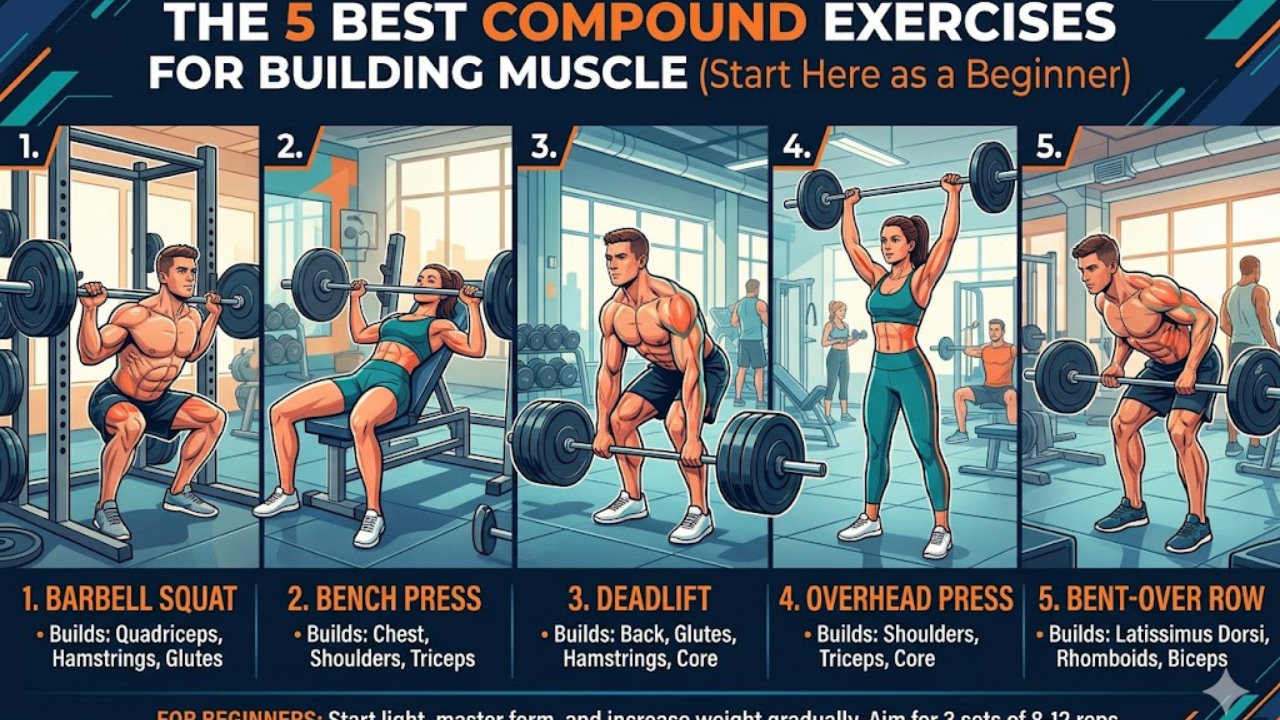
The 5 Best Compound Exercises for Building Muscle (Start Here as a Beginner)
The 5 Best Compound Exercises for Building Muscle (Start Here as a Beginner)
The 5 Best Compound Exercises for Building Muscle (Start Here as a Beginner)
The 5 Best Compound Exercises for Building Muscle (Start Here as a Beginner)
The 5 Best Compound Exercises for Building Muscle (Start Here as a Beginner)
The 5 Best Compound Exercises for Building Muscle (Start Here as a Beginner)
The 5 Best Compound Exercises for Building Muscle (Start Here as a Beginner)
The 5 Best Compound Exercises for Building Muscle (Start Here as a Beginner)
The 5 Best Compound Exercises for Building Muscle (Start Here as a Beginner)
The 5 Best Compound Exercises for Building Muscle (Start Here as a Beginner)
The 5 Best Compound Exercises for Building Muscle (Start Here as a Beginner)
The 5 Best Compound Exercises for Building Muscle (Start Here as a Beginner)
The Five Exercises
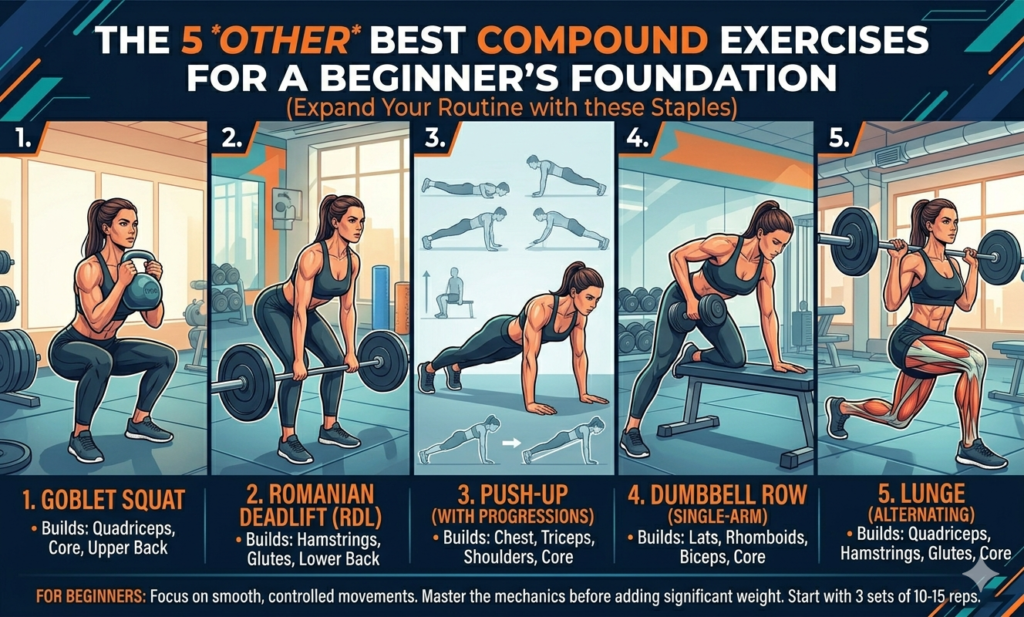
1. The Back Squat
The squat is the most complete lower body exercise in existence. Done properly, it builds your quadriceps, hamstrings, glutes, lower back, and core in a single movement. It also develops the kind of functional strength that transfers directly to everyday life — carrying groceries, climbing stairs, getting up off the floor.
How to perform it:
- Stand with feet roughly shoulder-width apart, toes pointed slightly outward
- Take the bar across your upper back (not your neck) and unrack with a straight spine
- Take a deep breath into your belly and brace your core
- Push your hips back and bend your knees simultaneously, keeping your chest up
- Lower until your thighs are at least parallel to the floor — deeper if your mobility allows
- Drive through your entire foot to stand, exhaling at the top
Beginner progression: Start with bodyweight squats to learn the pattern. Move to goblet squats (holding a dumbbell at your chest) once the movement feels natural. Transition to a barbell only when your form is consistent.
Most common mistake: Allowing the knees to cave inward as you push up. Focus on actively pushing your knees out throughout the entire movement.
2. The Conventional Deadlift
No exercise builds raw, total-body thickness like the deadlift. It hits the hamstrings, glutes, lower back, upper back, traps, and forearms — all in one pull. It also teaches your body to produce force from the ground up, which is the foundation of almost every athletic movement.
How to perform it:
- Stand with feet hip-width apart, the bar positioned over your mid-foot (about 2cm from your shins)
- Hinge at your hips and push them back, then grip the bar just outside your knees
- Before you pull, set your back flat — chest up, shoulders slightly in front of the bar, hips higher than your knees
- Take a breath, brace your core hard, and drive your feet into the floor
- Keep the bar dragging close to your body throughout the entire pull
- Lock out fully at the top — hips through, shoulders back
- Lower the bar with control by reversing the movement
Beginner progression: Romanian deadlifts with light dumbbells are the best way to learn the hip hinge pattern before touching a barbell. Spend two to four weeks here before progressing.
Most common mistake: Rounding the lower back at the start of the pull. This almost always comes from starting with your hips too low (treating it like a squat) or trying to lift more than you can handle with a neutral spine.
3. The Bench Press
The bench press is the definitive upper body pushing exercise. It primarily targets the pectorals (chest), with significant contribution from the anterior deltoids (front shoulders) and triceps. It’s the best single exercise for building a broad, powerful chest.
How to perform it:
- Lie flat on the bench, eyes directly under the bar
- Grip the bar slightly wider than shoulder-width — your forearms should be roughly vertical when the bar is at your chest
- Plant your feet flat on the floor, create a slight arch in your lower back, and retract your shoulder blades into the bench
- Unrack the bar and lower it with control to your mid-chest — don’t let it drop
- Press the bar back up in a slight arc, exhaling as you push, until your arms are fully extended
Beginner progression: If the barbell bench feels unstable or unbalanced, start with dumbbell chest press. This allows each arm to move independently and helps iron out any strength imbalances early.
Most common mistake: Flaring the elbows out at ninety degrees. This puts unnecessary strain on the shoulder joint. Keep elbows at roughly 45–75 degrees from your torso.
4. The Barbell or Dumbbell Row
If the bench press is the king of horizontal pushing, the row is the king of horizontal pulling. Rows build the latissimus dorsi, rhomboids, rear deltoids, and biceps — the muscles responsible for a wide, thick back and healthy shoulder function.
Neglecting back training is one of the most common beginner mistakes, and it shows — in poor posture, shoulder imbalances, and a physique that looks developed from the front but flat from behind.
How to perform it (dumbbell row):
- Place your left knee and left hand on a flat bench for support
- Hold a dumbbell in your right hand, arm hanging straight toward the floor
- Keep your back flat and parallel to the ground
- Pull the dumbbell upward toward your hip — not your shoulder — leading with your elbow
- Squeeze your back hard at the top of the movement
- Lower slowly over two to three seconds and repeat
Most common mistake: Using momentum to swing the weight up rather than pulling with the back muscles. If you’re swinging, the weight is too heavy. Drop it and focus on the contraction.
5. The Overhead Press
The overhead press builds shoulder size and strength like nothing else. It also requires your core, upper chest, and triceps to work hard — making it a genuine compound movement, not just a shoulder isolation exercise.
How to perform it:
- Stand with feet shoulder-width apart, barbell resting on your front deltoids at shoulder height
- Grip the bar just outside shoulder-width with elbows slightly in front of the bar
- Brace your core, squeeze your glutes, and press the bar straight overhead
- As the bar passes your forehead, push your head through the “window” created by your arms
- Lock out fully at the top, then lower with control
Beginner progression: Dumbbell shoulder press — seated or standing — is a great starting point. It’s more stable and easier to control while you develop the shoulder mobility for a barbell overhead press.
Most common mistake: Leaning back excessively to get the bar up. A slight lean is natural, but excessive arching turns this into a partial incline press and removes stress from the shoulders.
A Beginner Programme Built Around These Five Exercises
Train three days per week with at least one rest day between sessions. This gives you enough frequency for rapid early gains while allowing adequate recovery.
Session A:
- Squat — 3 sets of 8 reps
- Bench Press — 3 sets of 8 reps
- Barbell or Dumbbell Row — 3 sets of 8–10 reps
Session B:
- Deadlift — 3 sets of 5 reps
- Overhead Press — 3 sets of 8 reps
- Squat — 2 sets of 8 reps (lighter)
Alternate A and B each session. So week one is A, B, A. Week two is B, A, B. And so on.
Add a small amount of weight — 1.25 to 2.5kg — every time you successfully complete all sets with good form. This is progressive overload, and it’s the engine that drives every result you’ll get from this programme.
How Long Before You See Results?
Strength gains come within the first two to three weeks — often dramatically so. Visible muscle changes typically begin at eight to twelve weeks when protein intake is adequate (1.6–2g per kg of bodyweight daily) and training is consistent.
The first year of training is the most productive period most people will ever experience in the gym. Take it seriously. The gains available to a beginner who trains consistently and eats enough protein are genuinely remarkable.
Frequently Asked Questions
Do I need a gym to do these exercises? A barbell and a rack give you full access to all five. But all of them can be adapted with dumbbells for home training. The principles and results are identical.
Should I use machines instead? Machines have their uses, but they should supplement compound free weight movements — not replace them. Free weights develop the stabiliser muscles that machines bypass, leading to more complete and functional strength.
How much weight should I start with? Start lighter than you think you need to. The first two weeks are about learning movement patterns, not impressing anyone. Add weight methodically from a baseline where your form is solid.
Can women follow this programme? Absolutely. The same compound movements build muscle in women and men alike. Women will develop a leaner, more defined physique — not bulk — when training this way, especially at normal protein and calorie intakes.